July 28, 2025
By Kylie Flynn and Alice Klein
Gaps in children’s math development often begin before they enter kindergarten—and without early intervention, those gaps can widen and persist throughout elementary school and beyond. For children who enter preK with limited math knowledge, the odds of struggling later are high. But evidence from two recent studies shows there’s a way to intervene early—and effectively.
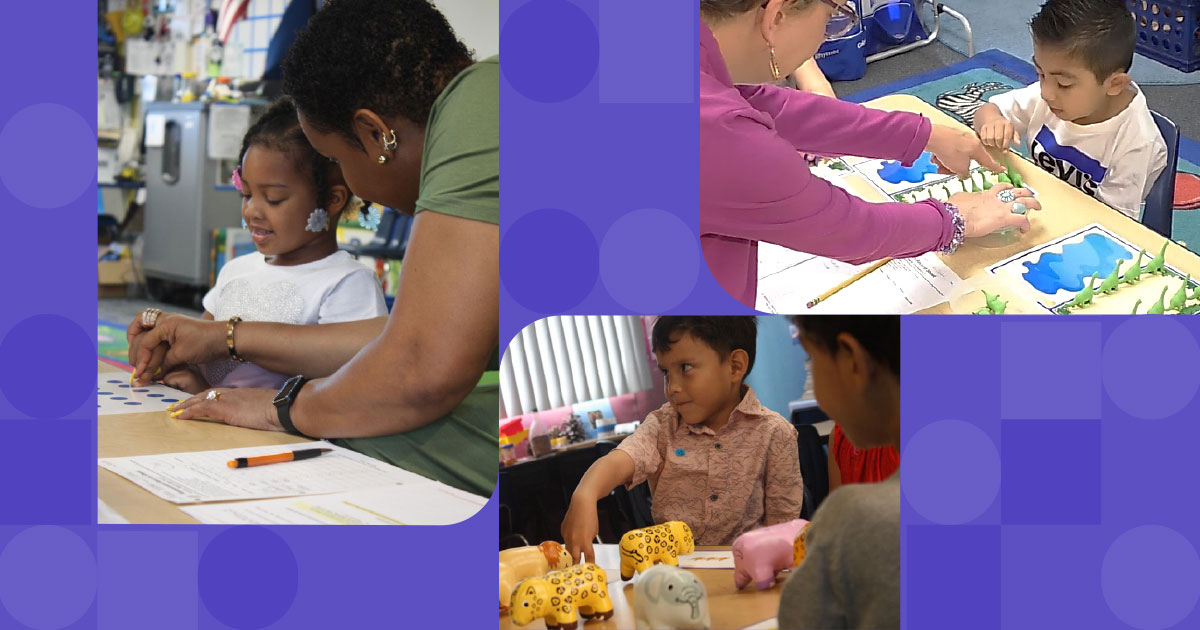
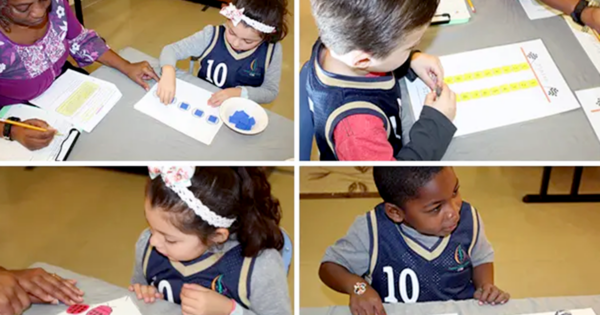
At the heart of this work is the PreK Mathematics Tutorial (PKMT), an intensive, small-group intervention designed to help children at risk for math difficulty build foundational knowledge through hands-on activities focused on number, operations, and spatial reasoning. In two randomized studies led by WestEd researchers, the intervention showed consistently positive results across different delivery models.
Delivering Results Across Early Math Settings
In one study, PKMT was delivered by tutors in a pullout setting—outside the classroom. In another, it was delivered by classroom staff within the classroom. Both models produced significant gains in math knowledge compared to business-as-usual instruction, with the pullout model showing slightly stronger effects. In both models, children receiving PKMT showed more growth than their peers—even those not initially identified as at risk.
This suggests that Tier 2 interventions can work when built into existing classroom structures—not just when delivered by specialists.
Implications for Early Math Policy and Practice
These findings add to a growing body of evidence showing that targeted, early interventions in math can make a meaningful difference for young learners. However, while PKMT helped reduce the gap in math skills between children who have been identified as at risk or not at risk, it did not eliminate it entirely. This points to the need for ongoing, sustained math support as students transition into kindergarten.
The studies also suggest that scaling effective interventions may be possible through flexible delivery models that meet the needs of different programs and settings—making early math success more achievable for more children.
Bottom Line: What Early Math Educators Can Do
Here are three actions education leaders can take to effectively support preK learners who are experiencing or might face challenges in math.
- Invest in early math interventions: Research-based, small-group tutorials can have a measurable impact, especially for children at risk.
- Explore flexible implementation: Both tutor-led and classroom-delivered models of PKMT were effective, offering options for different staffing and program structures.
- Plan for continuity: To close opportunity gaps, schools may need to extend Tier 2 math support beyond preK and into early elementary years.
Work With Us to Boost Early Math Learning
Our PreK Mathematics Workshops help close opportunity gaps through engaging instructional support for teachers and through coaching designed to help parents facilitate mathematics learning at home. Early education program staff receive technical assistance to sustain programwide mathematics support.
To connect with WestEd researchers or explore early math interventions in your setting, contact us.
About the Authors
Kylie Flynn is a former early childhood and special education teacher who partners with Head Start and state preschool programs across the country to provide professional learning and technical assistance, and to execute research projects that improve instructional practices.
Alice Klein is a child development expert whose work focuses on developing math intervention programs to enhance children’s early math learning and better prepare them for math instruction in elementary school.
More Related to This Post
Insights & Impact



Resources
Browse our high-quality publications and resources designed to inform and engage professionals in a variety of fields including K–12 education, early childhood, and health and justice.